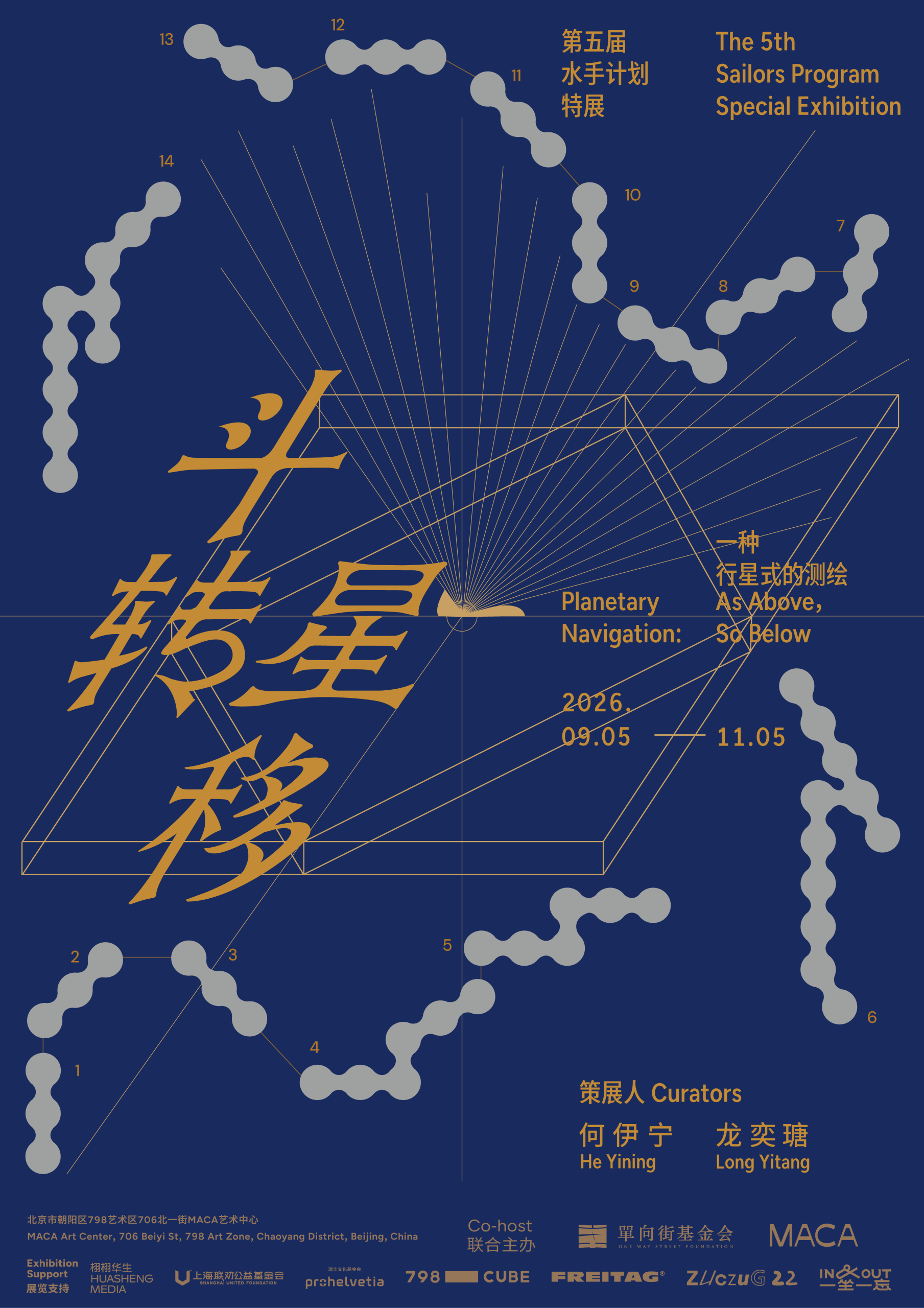
斗转星移:一种行星式的测绘
第五届水手计划特展

2026.09.05—11.05
艺术家:陈益青、陈逸飞、崔喻璇、何浩楠、劳伦·胡雷特、黎晨驰、亨特·朗捷、鲁雯泋、宋清羽、杨信 & 杨映梅、占有兵、赵燕娴、赵悦廷 & 谢丰玮
策展人:何伊宁、龙奕瑭
每一个时代都有自己的测绘方式。当今天的世界被卫星、算法与数据重新丈量,当具体的人被抽象为数据的光点,仍有一群人折返最古老的航线——以星辰为经,以大地为纬,像古老的水手一样,在行星的尺度上重新标定自身的位置。在坐标被不断重写、记忆被反复解域的时代,他们拒绝被数据定位,选择离开熟悉的港口,走向田野、废墟与远方。“在天成象,在地成形”——这句古旧的箴言,早已写下一种缠绕体感的导航术。
第五届水手计划的11组创作者与两位特邀瑞士艺术家,正是这样一群当代的远行者。 他们从北京胡同的肌理走向云南的深山,从圣赫勒拿的孤岛潜入跨国新能源产业链的工人档案,从祖辈的针脚里打捞劳动的记忆,也在老人的监控影像中凝视衰老的重量。航线彼此殊异,却共享同一片星图——在具体的田野中,寻回那些被时代洪流冲散、却依然微微闪烁的坐标。
展览以中国传统星图中的“北斗”与“南斗”作为方法论的经纬,织就一张关于“绵延与归藏”、“往昔与此刻”的双重叙事星丛。北斗七星既引航程,也喻示肃杀与凋零:展览的一侧聚焦于那些沉入地层深处的记忆——战争的废墟、殖民的伤口、劳工的离散与被封存的档案。艺术家们如同守夜人,在圣赫勒拿岛的孤寂里、在二战战俘营的秘密图绘与迁徙档案里、在跨越欧亚的工业地景与工人记忆里,打捞被时间吞噬的湮灭之痕。而南斗星群象征着延展与衍化:另一侧涌动着蓬勃的生命力与在地的韧性——植物的古老智慧、蜜蜂的神性辉光、民间的野生设计,以及老龄化社会中对“长寿”与“陪伴”的重新织造。这里有云南神蜂树下的共生,有胡同里野蛮生长的智慧,也有祖孙两代人通过针线缝合的时光。
在归藏与绵延的张力之间,是如同“左辅右弼”般的连接者。技术、媒介与公共参与,构成了展览的第三重维度。它们并非冰冷的工具,而是连接过去与未来的星桥——一针一线在白布上留下的温度可以成为跨越代际的诉说,一次田野录音可以让消逝的劳作之声重新响起。经由影像、声音与身体的介入,艺术家们将个体经验转化为公共记忆,将私人的痛楚转化为集体的疗愈。
在一个万物皆可被计算、却有更多存在拒绝被量化的时代,我们重拾“行星智慧”。MACA艺术中心在此化身为一座当代的“观星台”,邀请每一位踏入展厅的观众,像水手一样,在北斗的历史凝眸与南斗的生命流变之间,重新校准体内的星图,认领那颗仍在缓缓旋转的精神坐标。
本次展览由单向街基金会与MACA艺术中心联合主办。
Planetary Navigation: As Above, So Below
The 5th Sailors Program Special Exhibition
Venue: MACA Art Center
Artists: Chen Yiqing, Chen Yifei, Cui Yuxuan, He Haonan, Lauren Huret, Li Chenchi, Hunter Longe, Lu Wenhui, Pu Xiaoyue, Cherry Song , Yang Xin & Yang Yingmei, Zhan Youbing, Zhao Yanxian, Zhao Yueting & Will Xie
Curators: He Yining, Long Yitang
2026.09.05—11.05
Cartography is no longer just about geography; today, it is largely dictated by algorithms and data, often reducing lived experiences to mere digital coordinates. Yet, against this tide of abstraction, a distinct group of creators is looking back to older, more tactile ways of wayfinding. Navigating by the stars and the earth, they step away from the safety of familiar ports. They head into the field, the ruins, and the distant horizons, refusing to be pinned down by shifting digital maps. They remind us of an ancient, embodied practice: looking to the heavens to understand our place on the ground.
The eleven groups of creators in the 5th Sailors Program, alongside two invited Swiss artists, embody this spirit of contemporary voyaging. Some move from the fabric of Beijing’s hutongs to the deep mountains of Yunnan, from the island isolation of St. Helena into the worker archives of transnational renewable-energy supply chains, salvaging the memory of labor from the stitches of their forebears, and gazing at the weight of aging in surveillance footage of the elderly. Their routes are each distinct, yet they share a single star chart—within the concrete ground of fieldwork, they recover those coordinates scattered by the tide of the times, still glimmering faintly.
Structurally, the exhibition borrows from traditional Chinese astronomy, using the Big Dipper (Beidou) and the South Dipper (Nandou) as curatorial anchors to explore the tension between concealment and continuity. Traditionally, the Big Dipper governs solemnity and passing. Here, it guides us through submerged historical strata—war ruins, colonial scars, diasporic labor, and sealed archives. Like night watchmen, artists salvage traces of obliteration devoured by time—in the solitude of St. Helena, in the secret drawings and migration archives of WWII POW camps, and across trans-Eurasian industrial landscapes and worker memories.
In contrast, the South Dipper governs life and expansion. This section of the exhibition pulses with local resilience and ecological vitality. It highlights the ancient wisdom of plants, the sacredness of bee trees in Yunnan, vernacular design in urban alleys, and the intimate reweaving of companionship in an aging society. Here, we witness the wild, untamed wisdom that grows from the soil and the time stitched together across generations.
Bridging these two realms are the “companion stars” of technology, media, and public participation. Rather than treating technology as a cold, calculating force, the exhibition reclaims it as an empathetic star-bridge between past and future. The warmth of each stitch on white cloth becomes a testimony spanning generations; a field recording breathes life back into the vanished sounds of labor. Through images, sounds, and physical presence, private pain is translated into collective healing.
While we live in a time obsessed with quantification, much of human existence resists being measured. By turning the MACA Art Center into a temporary “observatory,” this exhibition invites visitors to become navigators themselves. Caught between the historical weight of the Big Dipper and the vital pulse of the South Dipper, we are asked to recalibrate our own internal maps and reconnect with a more grounded, planetary wisdom.
This exhibition is co-organized by the One Way Street Foundation and MACA Art Center.